
What Do Pilots Study to Master the Skies? Key Subjects Explained
What do pilots study to prepare for a life in the sky? It’s a lot more than learning how to take off and land. From the first day of ground school to the final checkride, pilots dive into a wide range of subjects that sharpen their judgment, build technical skills, and develop the confidence needed to fly safely and professionally.
Whether you’re aiming to fly recreationally or planning a career in aviation, knowing what goes into the academic side of pilot training will help you prepare and stay focused on what matters most.
Ground vs. Flight School: The Two Sides of Pilot Training
Every student pilot goes through two essential phases of training that work hand-in-hand to build confidence, safety, and skill. One focuses on what you know. The other sharpens what you do. Together, ground school and flight training form the foundation of every pilot certificate, whether you’re pursuing a private license or aiming for the airlines.
Ground School
Ground school builds your understanding of how flying works and why pilots make certain decisions in different situations. It provides the knowledge foundation that supports every action you take in the cockpit. During this phase, you learn how the aircraft operates, how to read the sky, and how to navigate safely and legally in the national airspace system.
Typical subjects include:
- FAA regulations and airspace classifications
- Weather theory, forecasts, and interpretation methods
- Aircraft engines, systems, and basic aerodynamics
- Weight and balance calculations for safe performance
- Navigation techniques, radio communication, and emergency planning
Ground school can be completed in a classroom, through online coursework, or in a blended format. Many students begin ground study at the same time as flight lessons, allowing them to connect theory to real flying right away. This approach helps reinforce learning and makes each flight lesson feel more intuitive and productive.
Flight Training
Once you’ve started building your knowledge base, it’s time to apply it in the air. With an instructor by your side, you’ll begin practicing takeoffs, landings, stalls, turns, slow flight, emergency procedures, and radio work. You’ll also learn how to handle real-world scenarios, such as changing weather, traffic patterns, and navigation challenges.
Flight lessons bring theory to life and help you develop good habits, situational awareness, and confidence behind the controls.
Both components are required for every certificate, and many students find that doing them in parallel keeps the learning experience balanced and practical. When ground knowledge and flight skill work together, true progress takes shape.
The Aviation Curriculum: What Pilots Actually Study
There’s a structured body of knowledge every pilot learns, whether you’re pursuing a private certificate or aiming for a commercial career. These subjects give you the tools to fly safely, confidently, and legally in all kinds of conditions.
1. Aerodynamics
Understanding how an aircraft behaves in the air is foundational. You’ll study the four aerodynamic forces: lift, drag, thrust, and weight, and how they interact in different phases of flight. You’ll also dive into stall behavior, spin awareness, and what makes an aircraft stable—or unstable—during maneuvers. These concepts shape everything from how you plan a takeoff to how you recover from a stall.
2. Aircraft Systems
Every pilot needs to understand how their aircraft works. That includes the engine, fuel system, electrical system, and landing gear. As you advance, you’ll also cover complex systems like constant-speed propellers, retractable gear, and pressurization systems. For students training in glass cockpit aircraft, becoming fluent in modern avionics like the G1000 is essential for both navigation and systems awareness.
3. Flight Instruments
Flight instruments give pilots the information they need to control the aircraft safely and accurately. You’ll start by learning the traditional “six-pack”: airspeed indicator, attitude indicator, altimeter, turn coordinator, heading indicator, and vertical speed indicator. These instruments provide critical data about your speed, orientation, and altitude, especially when outside visual references are limited.
As you move into modern glass cockpit systems like the Garmin G1000, you’ll study how digital displays consolidate and present flight data. You’ll also begin learning the basics of instrument flight, which teaches you how to fly using instruments alone. This is an essential skill for flying in clouds, at night, or in any low-visibility conditions.
4. FAA Regulations (Parts 61, 91, etc.)
Pilots are expected to know the rules inside and out. That means understanding what you’re allowed to do at each license level, how airspace is structured, and what weather minimums apply to different types of flight. You’ll also study maintenance requirements, equipment mandates, and airworthiness standards.
5. Weather Theory & Aviation Meteorology
Weather affects every flight, and pilots need to understand how to read the skies and the charts. You’ll learn how temperature, pressure, and wind shape flight conditions. You’ll also work with METARs, TAFs, radar imagery, and forecast tools. Beyond decoding reports, you’ll learn how to make go/no-go decisions around thunderstorms, turbulence, and icing.
6. Navigation and Flight Planning
This subject ties your knowledge and judgment together. You’ll learn how to chart a course using pilotage, dead reckoning, VORs, and GPS. Planning a cross-country flight means accounting for fuel burn, alternate airports, time en route, and weather changes. You’ll train for both high-tech and no-tech navigation so you’re always prepared.
7. Radio Communication & Phraseology
Clear, confident radio communication is a core part of flight training. You’ll practice the standard phraseology used with air traffic control, learn how to navigate both towered and non-towered airports, and get comfortable talking on the radio. For many students, this is one of the most intimidating parts of training, but it gets easier with every call.
8. Human Factors and Aeromedical Knowledge
Pilots are taught to manage risk not just from the aircraft, but from themselves. You’ll study how fatigue, alcohol, stress, medications, and altitude can impair your performance. This subject also covers situational awareness, crew resource management, and the risks of spatial disorientation, especially during night or instrument flight.
9. Flight Maneuvers and Procedures
You’ll practice the core maneuvers needed for every certificate. This includes slow flight, steep turns, stalls, and emergency procedures. You’ll also work on consistent, smooth takeoffs, landings, and go-arounds. As you move into commercial training, you’ll add more advanced maneuvers like chandelles, lazy 8s, and power-off 180s.
10. Weight & Balance + Performance Calculations
Before every flight, you’ll calculate how loading and environmental factors affect your aircraft. This includes weight and balance checks, takeoff and landing distances, and adjustments for density altitude, which is particularly important in Arizona’s heat and elevation. These calculations are a legal and practical requirement, ensuring every flight stays within safe performance limits.
What Do the Written Tests Cover?
Before earning any pilot certificate, you’ll need to pass an FAA written knowledge test. These exams check that you understand the subjects you’ve been studying in ground school and flight training and that you’re ready to move on to the next stage.
The Basics of the Test
The FAA written tests are multiple-choice and typically include 60 to 100 questions, depending on the certificate level. Topics come from across the aviation knowledge spectrum and are based on specific FAA learning objectives. The tests are standardized and taken at approved testing centers.
Most students use a mix of learning tools to prepare:
- Online ground school programs
- In-person instruction
- FAA handbooks and resources
- Test prep apps and practice exams
Combining these resources helps reinforce your understanding and improves retention.
Subjects You’ll See on the Test
You can expect questions pulled from all core areas of aviation training. This includes:
- Aerodynamics and aircraft systems
- Weather theory and interpretation of forecasts
- Navigation, flight planning, and performance calculations
- Regulations, airspace classifications, and VFR/IFR rules
- Instrument and flight operations
- Human factors, aeromedical information, and decision-making
Each question is designed to check both your understanding of the material and your ability to apply it in real-world scenarios.
Support to Make It Smoother
Studying for the written doesn’t have to be overwhelming. Students benefit most from a structured approach that follows FAA guidelines closely. At Leopard Aviation, our materials and instruction are designed to match the test standards, helping you walk in confident and ready.
Training at Leopard Aviation — Learn from Day One to Career-Ready
At Leopard Aviation, we teach you to think, speak, and fly like a professional from day one. Whether you’re starting your Private Pilot License or working toward your Commercial License, we build the mindset and skills that carry through your entire flying career.
Our program balances top-tier flight instruction, advanced aircraft, and a strong support system. We’re here to guide your path—and make sure you enjoy the journey along the way. We believe flying is fun and learning to fly should also be fun!
The Training Path: Private and Commercial Under Part 61
We’re certified under Part 61 of the FAA’s training regulations, which allows us to tailor your experience while maintaining high standards. You’ll start with the Private Pilot License and can continue straight through to Commercial training with us.
This structure gives you room to grow at your own pace while staying focused on practical, real-world aviation skills.
The Leopard Aviation Difference
We’re a family-owned and operated flight school, and that energy shows in how we train. We believe great instructors build great pilots, and we invest in both. Our Certified Flight Instructors bring real-world experience—some have flown airliners, others captain business jets—but all of them love what they do, and it’s contagious.
We’ve created a training culture that’s fun, supportive, and built on mutual respect. You’re not just a number here. You’re part of the mission: to become one of the best-trained pilots in the sky.
Modern Aircraft, Real-World Experience
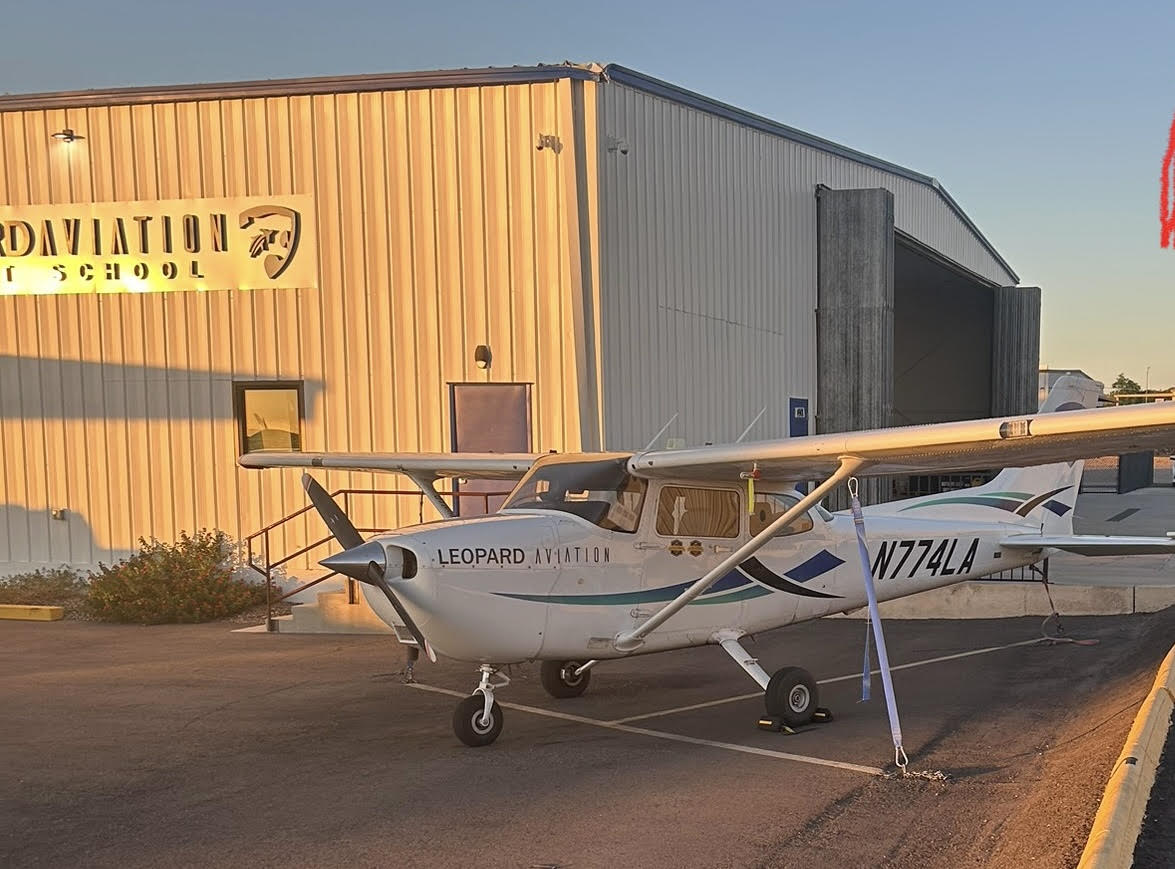
We train in Cessna 172S Skyhawks equipped with Garmin G1000 glass cockpits, GFC700 autopilot, and full ADS-B in/out capability. These aircraft give you real-time situational awareness and a modern training platform that mirrors what you’ll find in today’s commercial cockpits. They’re safe, reliable, and a lot of fun to fly.
Ground Support That Makes a Difference
- Ground school support that connects directly with FAA test material
- Test prep tools and resources to boost your confidence
- Flexible scheduling that works with your life
- A friendly, encouraging environment that makes learning easier
We break down complex topics and bring them to life in the air. Every lesson has a purpose. Every flight builds on what you’ve learned. And throughout it all, we’re here to guide, support, and cheer you on.
Take the First Step with a Discovery Flight
If flying has always been in the back of your mind, now’s the time to see what it actually feels like. Schedule a Discovery Flight out of our Mesa or Scottsdale location and get a hands-on intro to flight training with one of our Certified Flight Instructors.
You’ll sit up front, take the controls, and get a real taste of what it’s like to fly a high-performance, modern aircraft. Whether you’re exploring a new career or just crossing off a bucket-list dream, we’re here to help you make it real—on your schedule, and at your pace.
Ready for Takeoff?
Every skilled pilot starts in the same place: learning the fundamentals, building real-world skills, and training with people who know what it takes to succeed. From core subjects like weather, navigation, and aerodynamics to hands-on flight instruction, the path is challenging but incredibly rewarding.
At Leopard Aviation, we bring together the right instructors, top-tier aircraft, and a training culture that’s both professional and personal. Whether you’re aiming for a career in aviation or chasing a lifelong dream, we’re ready when you are. Take the first step today and schedule your flight training lesson.
FAQs
What subjects are covered on the FAA written test?
You’ll see questions on aerodynamics, weather, navigation, flight instruments, regulations, aircraft systems, and more. It’s all designed to make sure you understand the essentials of safe flying. Most students prep with online courses, books, and practice exams, and with steady study, it’s absolutely passable, especially if you understand the “why” behind the answers.
How long does it usually take to get a Private Pilot License?
Most students earn their PPL in 4 to 6 months with consistent training. That can vary depending on your schedule, frequency of lessons, and weather conditions. Flying regularly (at least twice a week) can help you stay sharp and make faster progress toward your license.
Is flight training hard to learn without any background in aviation?
It’s totally doable, even if you’re starting from scratch. Flight training is designed to take you from zero to certified step by step. A good instructor breaks down complex topics into clear, real-world examples. If you bring focus and curiosity, you’ll be surprised how fast things start to click.
What do pilots study to prepare for flying professionally?
In training for a career, pilots study everything from aircraft systems and weather to advanced maneuvers, instrument flying, and FAA regulations. Commercial training also adds complex aircraft handling and high-level decision-making. It’s a mix of classroom learning and hands-on flying designed to build both skill and judgment.
Can I train around my work or school schedule at Leopard Aviation?
Yes. One of the benefits of our Part 61 program is flexibility. We’ll work with you to create a schedule that fits your life, whether you’re training full-time or flying on weekends and evenings. You’ll go at your pace, without pressure, but with full support.
Who will be teaching me to fly at Leopard Aviation?
Our Certified Flight Instructors come from all kinds of backgrounds—former airline captains, corporate pilots, and career CFIs. All of them share a passion for flying and teaching. We make it a priority to pair you with the instructor who fits your learning style and goals.
How do I know if aviation is right for me?
That’s exactly what our Discovery Flights are for. You’ll go up with a Certified Flight Instructor, get a feel for the aircraft, and even take the controls. It’s a no-pressure way to experience what it’s like to fly—and it often sparks the “I need to do this” moment.