
Parts of a Plane: A Beginner’s Guide for Aspiring Pilots
If you’ve ever wondered about the parts of a plane and what makes an aircraft actually fly, you’re already thinking like a pilot. Understanding your airplane is all about building the confidence and safety awareness that separates good pilots from great ones. Before every flight, you’ll walk around your aircraft and physically inspect these components, checking for anything that could compromise your safety in the air. On your FAA checkride, your examiner will expect you to identify parts, explain their functions, and describe what would happen if they failed.
At Leopard Aviation, we train pilots in modern Cessna 172S Skyhawks in sunny Phoenix, Arizona, and we make sure every student understands their aircraft inside and out. You don’t need to be a mechanic to earn your pilot’s license, but knowing how your airplane works builds the kind of situational awareness and decision-making skills that keep you safe throughout your flying career. Let’s break down the essential parts of a plane and what each one does to keep you flying.
The Fuselage: Understanding the Main Body of Your Aircraft
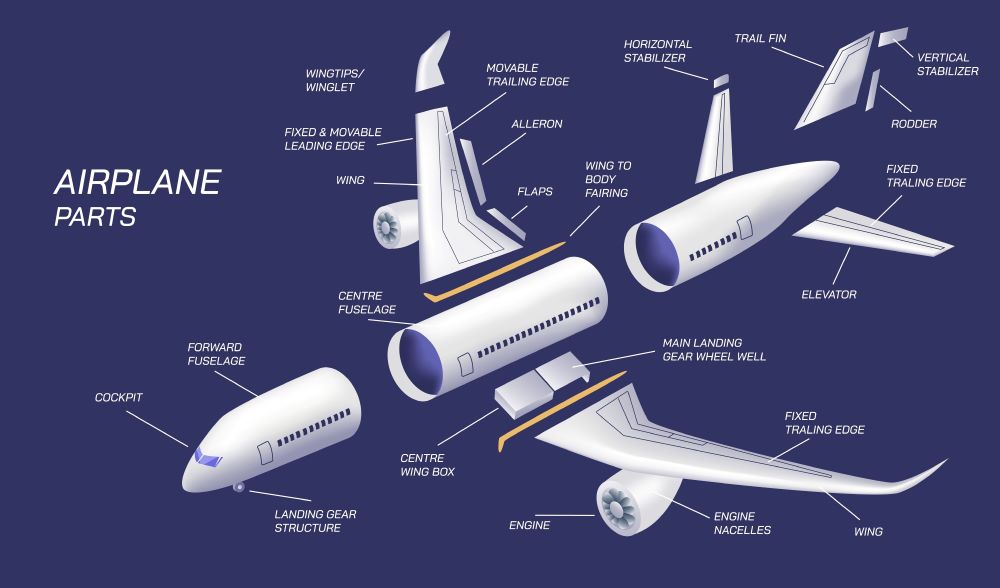
The fuselage serves as the primary structural component that houses the cockpit, passenger seats, and cargo area. It’s where you sit, where your passengers ride, and where luggage and equipment are stored. Beyond just providing space, the fuselage connects the wings, tail section, and landing gear, creating a unified structure that can withstand the forces of flight.
The fuselage also plays an aerodynamic role. Its shape is designed to minimize drag as air flows over and around it during flight. A streamlined fuselage reduces resistance, which improves fuel efficiency and overall performance. On aircraft like the Cessna 172S that we fly at Leopard Aviation, the fuselage design balances structural strength with aerodynamic efficiency.
As a student pilot, you need to know where specific components are mounted on the fuselage and what they do:
- Antennas: Communication and navigation antennas are mounted on the fuselage exterior and must remain undamaged for proper radio function
- Static ports: These small openings measure ambient air pressure and feed critical flight instruments like your altimeter and airspeed indicator
- Aerodynamic impact: Damage to the fuselage surface, like dents or protruding rivets, can disrupt airflow and affect performance
Preflight Inspection Considerations
Before every flight, you’ll walk around the fuselage and inspect it carefully. You’re looking for dents, loose panels, missing screws, or any signs of damage that could compromise structural integrity or aerodynamics. You’ll check that access doors are secured, that antennas are intact, and that static ports are clear of obstructions. This hands-on inspection builds your understanding of the aircraft and ensures you catch potential problems before they become safety issues in the air.
The Wings: How Airfoils Create Lift and Keep Your Aircraft Flying
Wings use an airfoil shape (curved on top, flatter on the bottom) to create lift as air flows over them. The curved upper surface causes air to move faster over the top of the wing than underneath, creating lower pressure above and higher pressure below. This pressure difference generates upward force that lifts the aircraft off the ground and keeps it flying.
In many training aircraft, the wings also house fuel tanks. Fuel is stored in compartments within each wing and gravity-feeds or pumps to the engine. The wings also contain critical control surfaces: flaps and ailerons. Flaps extend from the trailing edge to increase lift and drag during takeoff and landing, while ailerons control roll by moving in opposite directions on each wing.
Understanding the anatomy of the wing helps you conduct thorough preflight inspections:
- Leading edge: The front of the wing that meets oncoming air first
- Trailing edge: The rear of the wing where airflow separates
- Wing struts: Structural supports on high-wing aircraft like the Cessna 172 that connect the wing to the fuselage
What You’ll Do During Preflight
Before every flight, you’ll sump fuel from drain points on the wings to check for water contamination or debris. You’ll visually inspect hinges on the ailerons and flaps to ensure they’re secure and moving freely. You’ll check the wing surfaces for damage, loose rivets, or anything that could disrupt airflow. During your training at Leopard Aviation, you’ll learn how extending flaps changes lift and drag characteristics during different phases of flight, and how aileron inputs control your bank angle and turning.
Learn Aircraft Systems Hands-On at Leopard Aviation
At Leopard Aviation, we believe understanding your aircraft deeply makes you a safer, more confident pilot. Our instructors take the time to walk you through every component during preflight inspections, explaining not just what you’re looking at but why it matters. When you train with us in Scottsdale or Mesa, you’ll get hands-on experience with modern Cessna 172S Skyhawks, learning the systems and components that make flight possible. Ready to start learning? Schedule your Discovery Flight today and see what it’s like to fly an aircraft you truly understand.
Ailerons: The Control Surfaces That Let You Bank and Turn
Ailerons are the moveable control surfaces located on the outer trailing edge of each wing. They move in opposite directions to control the airplane’s roll axis. When you turn the yoke or control stick to the left, the left aileron deflects upward while the right aileron deflects downward. The upward-deflected aileron reduces lift on that wing, causing it to drop, while the downward-deflected aileron increases lift on the opposite wing, raising it. This differential lift creates a rolling motion around the airplane’s longitudinal axis, banking the aircraft in the direction you want to turn.
The opposite movement of the ailerons is what makes controlled banking possible. Without this coordinated deflection, you wouldn’t be able to precisely control your bank angle or maintain coordinated flight during turns.
You control the ailerons through the yoke in the cockpit. Turning the yoke left or right directly commands the ailerons to deflect and roll the aircraft. Coordinated flight is critical, and ailerons play a central role. You’ll learn to combine aileron inputs with rudder to prevent adverse yaw and keep your turns smooth and balanced.
During your preflight inspection, you’ll check that the ailerons move freely through their full range of motion and that the hinges are secure and undamaged.
Flaps: Helping You Take Off and Land Safely
Flaps are moveable surfaces on the inboard trailing edge of the wings that extend downward to increase both lift and drag. They allow you to take off and land in shorter distances by increasing lift at slower airspeeds.
During takeoff, partial flaps help you get airborne more quickly. During landing, full flaps enable slower, steeper approaches with better visibility and more precise touchdown control. You’ll learn specific flap settings for normal takeoffs, short-field landings, and soft-field operations.
Flap misuse is a common early student mistake—extending them too early, retracting too quickly, or exceeding flap speed limits—but these mistakes become valuable lessons that sharpen your understanding of aircraft performance.
The Empennage (Tail Section)
The empennage is the tail section of the aircraft. If you’re not familiar with the term, it’s just the formal name for the tail components that provide stability and control pitch and yaw.
Components of the Empennage
The vertical stabilizer is the fixed vertical surface providing directional stability. The rudder attaches to its trailing edge and controls yaw—left and right nose movement. The horizontal stabilizer is the fixed horizontal surface providing pitch stability. The elevator attaches to its trailing edge and controls pitch—nose-up and nose-down movement.
The Rudder: Controlling Yaw
You operate the rudder with foot pedals. Pushing the left pedal yaws the nose left; pushing right yaws it right. You’ll use rudder constantly during takeoff and landing, especially in crosswinds. Coordinated flight means balancing aileron and rudder inputs together. Without proper coordination, the aircraft can skid (tail slides outward) or slip (nose points too far into the turn). Both are inefficient and tested concepts on your checkride.
The Elevator: Controlling Pitch
The elevator controls pitch attitude. Pulling the yoke back raises the elevator and pitches the nose up. Pushing forward lowers it and pitches the nose down. You’ll use elevator inputs during every phase of flight to maintain altitude, establish climbs and descents, and execute landings. Smooth, precise elevator control takes practice but becomes second nature.
The Engine and Propeller
The engine generates power, and the propeller converts that power into thrust by pulling air rearward and pushing the aircraft forward.
As a student pilot, you need basic understanding of your engine type. Carbureted engines mix fuel and air using a carburetor and can develop carburetor icing. Fuel-injected engines deliver fuel directly to cylinders, eliminating icing concerns but requiring different starting procedures.
You’ll learn to use the mixture control to adjust the fuel-to-air ratio based on altitude. The oil system lubricates and cools the engine. During preflight, you’ll check oil level, inspect air intakes for obstructions, and examine the propeller for damage. Even small nicks can create stress points leading to failure, so any visible damage grounds the aircraft.
Landing Gear
Landing gear supports the aircraft on the ground and absorbs landing impact. There are three main types:
- Tricycle gear (most common in trainers like the Cessna 172S) features two main wheels and a nose wheel. It’s stable and easy to control during taxi, takeoff, and landing.
- Tailwheel gear places main wheels forward with a small tail wheel. These aircraft require more skill and are typically pursued later in training.
- Retractable gear extends or retracts during flight to reduce drag and is found on more advanced aircraft.
During training at Leopard Aviation, you’ll learn how to inspect tires for wear, check brake condition, and examine struts for proper extension and leaks. Proper landing technique protects landing gear from damage, especially during hard landings. Learning to flare correctly and touch down smoothly takes practice but is essential for safety.
How Leopard Aviation Teaches You to Understand Your Aircraft From Day One
At Leopard Aviation, we believe that truly understanding your aircraft makes you a safer, more confident pilot from your very first lesson. We start teaching you about aircraft systems during your very first preflight inspection. You won’t just watch your instructor walk around the airplane, you’ll be right there with them, touching each component, learning what to look for, and understanding why each check matters. Our instructors take the time to explain not just what you’re inspecting but how each part functions and what could go wrong if it fails.
This hands-on approach builds muscle memory and understanding simultaneously. By the time you’re ready for your checkride, you won’t be cramming to memorize aircraft components. You’ll know them because you’ve inspected them dozens of times and discussed their function in the context of real flights.
Modern Aircraft With Advanced Systems
We train you in Cessna 172S Skyhawks equipped with Garmin G1000 glass cockpit avionics. These aircraft represent the modern standard in general aviation, and learning on them prepares you for the technology you’ll encounter throughout your flying career. Here’s what makes our training fleet effective:
- Well-maintained aircraft: Our planes are newer, safer, and more reliable, giving you confidence during training
- G1000 avionics: You’ll learn glass cockpit systems from the beginning, not outdated steam gauges
- Consistent fleet: Training in the same aircraft type throughout your progression builds familiarity and proficiency
- Real-world preparation: The systems you learn in our 172S translate directly to more advanced aircraft
Instructors Who Emphasize Understanding
Our Certified Flight Instructors include former airline captains and corporate pilots who understand that systems knowledge separates good pilots from great ones. They emphasize three key areas during your training: deep systems understanding so you know how everything works together, safety awareness so you can identify potential problems before they become emergencies, and real-world application so you understand how textbook knowledge applies to actual flying situations.
When your instructor has flown professionally, they bring practical insights that go beyond the FAA test standards. They’ll explain how understanding your fuel system helps you make better decisions about fuel stops on cross-country flights, or how knowing your electrical system helps you troubleshoot issues if a circuit breaker pops during flight.
Year-Round Training in Ideal Conditions
Based in Scottsdale and Mesa, Arizona, we offer year-round training in some of the best flying weather in the country. Consistent weather means you’re not constantly rescheduling lessons due to poor conditions, which helps you progress faster and retain what you’ve learned. The busy Phoenix-area airspace also gives you real-world experience that sharpens your skills and prepares you for flying anywhere.
See These Parts Up Close
Ready to start learning? Schedule a Discovery Flight with us and see these aircraft components up close—not just in pictures or diagrams, but on an actual airplane you’ll be flying. You’ll conduct a preflight inspection with one of our experienced instructors, take the controls, and experience what it’s like to train with a flight school that takes systems knowledge seriously.
Ready to Learn Your Aircraft From the Ground Up?
Understanding the parts of a plane transforms you from a passenger into a pilot who knows exactly what’s happening during every phase of flight. From the fuselage that holds everything together to the wings that generate lift, from the control surfaces that manage pitch, roll, and yaw to the engine and propeller that provide thrust, each component plays a critical role in keeping you safe in the air. Knowledge builds confidence, and confidence makes you a better decision-maker when things don’t go according to plan.
At Leopard Aviation, we teach you these systems hands-on from your very first lesson. Our instructors take the time to explain not just what each part does, but why it matters and how it affects your flying. Ready to stop looking at pictures and start inspecting real aircraft? Schedule your Discovery Flight with us in Scottsdale or Mesa today. Let’s get you in the cockpit of a Cessna 172S where you can touch these components, understand how they work, and experience what it feels like to fly an airplane you truly know inside and out.
FAQs
What are the most important parts of a plane that student pilots need to know?
The most critical components are the wings (which generate lift), control surfaces (ailerons, elevator, and rudder), the engine and propeller (which create thrust), and the empennage or tail section (which provides stability). You’ll also need to understand the fuselage structure, landing gear, and fuel system. During your training, you’ll learn not just to identify these parts but to explain their functions and what happens if they fail, which is essential knowledge for your FAA checkride.
How does Leopard Aviation teach students about aircraft components during training?
We start teaching aircraft systems during your very first preflight inspection. You’ll walk around the aircraft with your instructor, physically touching and inspecting each component while learning what it does and why it matters. We don’t just show you pictures in ground school—we get you hands-on with the actual Cessna 172S you’ll be flying. Our instructors explain systems in the context of real-world flying, so you understand not just what something is, but how it affects your decisions in the cockpit.
How long does it take to memorize all the aircraft parts and systems?
You don’t need to memorize everything at once. Aircraft knowledge builds gradually throughout your training. By the time you’re ready for your Private Pilot checkride, you’ll have conducted dozens of preflight inspections and discussed systems with your instructor repeatedly. The repetition creates natural retention, so you’re not cramming the night before your checkride. Most students find that after 20-30 hours of flight training, aircraft systems feel familiar rather than overwhelming.
How does Leopard Aviation make learning aircraft systems easier for visual learners?
We believe the best way to learn aircraft systems is by seeing and touching them, not just reading about them in textbooks. Our hands-on training approach means you’re physically interacting with every component during preflight inspections. We also use the G1000 avionics in our aircraft to show you real-time system information during flight, which helps visual learners connect concepts to actual operation. Our instructors tailor their teaching style to match how you learn best, whether that’s visual, hands-on, or through detailed explanations.
Are flaps and ailerons the same thing?
No, they’re different control surfaces with different functions. Flaps are located on the inboard trailing edge of the wings and extend downward to increase lift and drag during takeoff and landing. Ailerons are on the outboard trailing edge and move in opposite directions to control roll and banking. Flaps are used primarily during takeoff and landing phases, while ailerons are used constantly throughout flight to control banking and turns. Both are critical, but they serve very different purposes.